
Amazon does not raise FBA the way a utility raises a rate. It edits the operating system you sell through. Fulfillment, storage, inbound placement, aged inventory, returns, and a fuel line that comes back when diesel is a headline — that is the P&L, not the referral fee you memorized in 2019. This is the history we actually use when we tell a catalog to keep Keepa open and to stop believing an Xray score.
If you only remember one sentence: the fee that killed your last “winning” product was probably storage in October, not the $0.08 fulfillment bump Amazon put in a press note. Run the live numbers in our FBA calculator and the storage calculator before you inbound a three-month cover into September.
The three taxes hiding in “FBA”
Sellers still talk about “the FBA fee” as if it were one line. It is three different businesses Amazon runs on your inventory:
- Fulfillment per unit — pick, pack, ship. Varies by size-tier, shipping weight, and (since 2026) the item’s price band. This is the number people screenshot.
- Monthly storage — cubic feet in the building. Cheap from January to September. A different product in Q4. Utilization surcharges if you sit fat relative to your outbound.
- Time penalties — aged inventory, low-inventory-level fees in some years, inbound placement if you will not split the freight the way Amazon’s network wants.
Referral is separate. Ads are separate. Returns are separate. If your profit module in Helium 10 looks prettier than Sellerboard, believe Sellerboard. That is in the testing notes.
A timeline you can actually operate against (2020–2026)
We do not republish a 2015 blog’s rate card and pretend it is scripture. Amazon edits SKUs. What follows is the policy history — the moves that changed how a serious catalog plans inbound — with the official 2026 math at the bottom.
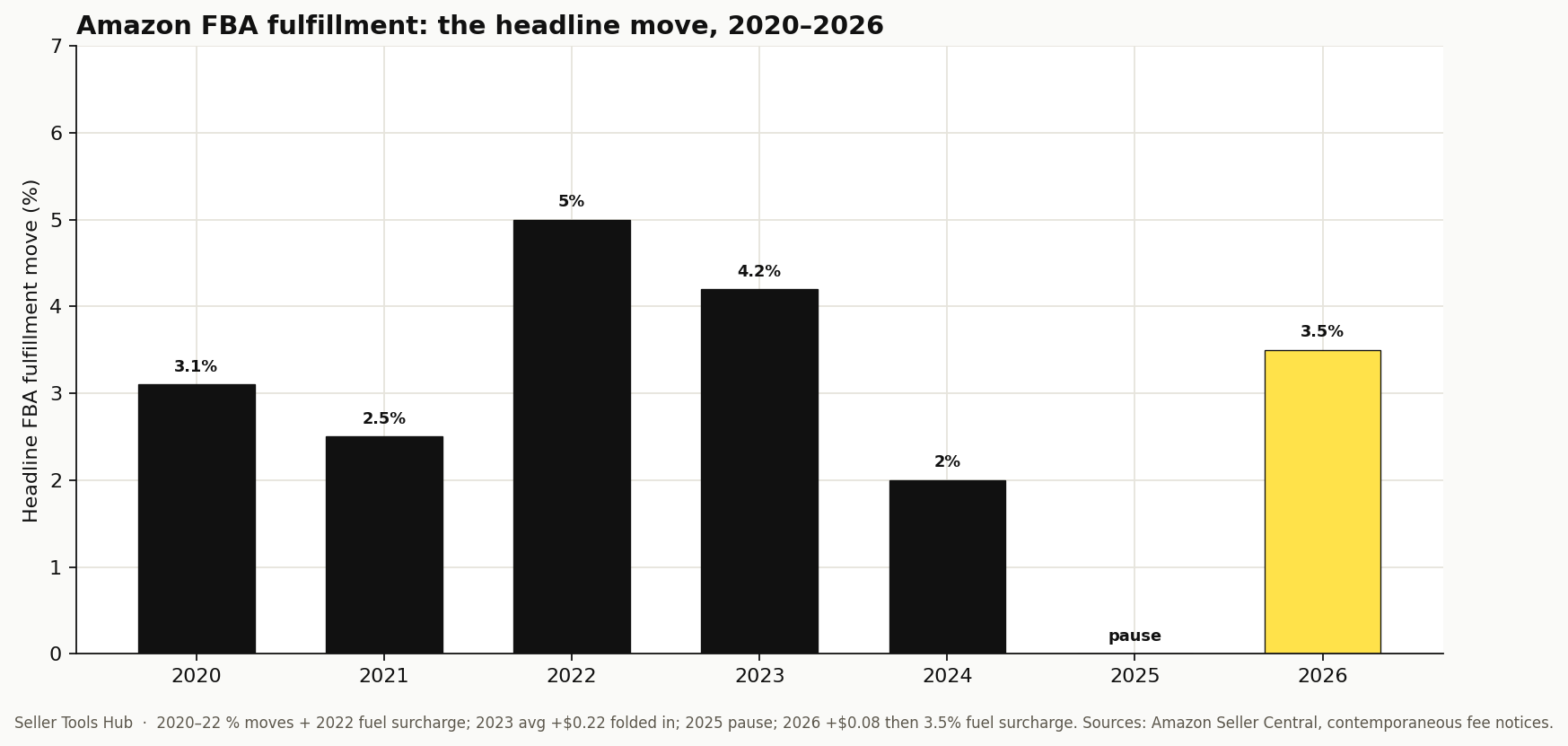
| When | What Amazon actually did | What it did to a catalog |
|---|---|---|
| 18 Feb 2020 | US FBA fulfillment up a little over 3% on average. | Still a rounding error if you had a real margin. The last “normal” year before COVID inventory chaos. |
| 1 Jun 2021 | Fulfillment up ~2–3%. | Everyone was restocking. Nobody wanted to hear about $0.15. |
| 18 Jan 2022 | Rates reset to “permanent operating costs.” | The post-COVID building is more expensive. Amazon stopped pretending otherwise. |
| 28 Apr 2022 | 5% fuel and inflation surcharge on FBA fulfillment. | The first time a “temporary” line item showed up on every unit. Remember this in 2026. |
| 15 Oct 2022 – 14 Jan 2023 | Holiday peak fulfillment surcharge on core FBA, apparel, dangerous goods. | Q4 is no longer just storage. Outbound costs spike when you most want to ship. |
| 17 Jan 2023 | Fuel surcharge folded into base rates. Outbound up ~$0.22 per unit on average. | The surcharge did not die. It got a promotion. |
| Apr 2023 | Storage utilization surcharge. Aged inventory expanded, including 180–270 day bands in many categories. | Sitting on a “winning” bet became a fee product Amazon sells you. |
| 1 Mar 2024 | Inbound placement service fee if you will not distribute freight across Amazon’s network. | A new tax on lazy inbound. Split shipments or pay. |
| 1 Apr 2024 | Off-peak standard-size storage cut $0.09 / cu-ft. | The rare gift. Use it. Do not inbound Q4 cover in August because of it. |
| 15 Jan 2025 | Amazon paused most US referral and FBA fulfillment increases. No new fee types. | A political and PR pause. Plan as if 2026 would resume the OS updates. It did. |
| 15–16 Jan 2026 | Fulfillment up ~$0.08 per unit on average — Amazon’s words: less than 0.5% of an average item’s selling price. AWD West storage $0.48 → $0.57 / cu-ft. New 456-day aged tier. | The average is a lie if you sell small standard above $50. See the table below. |
| 17 Apr 2026 | 3.5% fuel and logistics surcharge on FBA fulfillment in the US and Canada. Amazon’s own help text. Contemporaneous recaps put the average around $0.17 per US FBA unit. | 2022’s ghost. If your 2026 plan assumed the January rate card was the year, redo the sheet. |
Sources: Amazon Seller Central help pages for 2024 storage and 2026 US referral/FBA changes; Amazon’s April 2026 fuel/logistics surcharge notice; contemporaneous operator recaps of 2020–2023 fulfillment notices. Always open the live rate card. We are not Amazon.
2026 fulfillment: the average is $0.08. Your SKU is not average.
Amazon’s 2026 summary said fulfillment would rise by an average of eight cents, or less than half a percent of an average item’s selling price. That sentence is written for journalists. The rate card is written for size-tier and price-band.
Small standard-size (the 18 × 14 × 8 in, 20 lb world most private-label catalogs live in) moved like this on 15 January 2026, before the April surcharge:
| Size / price | Per-unit change vs 2025 | Who it hits |
|---|---|---|
| Small standard, under $10 | about +$0.12 | Cheap accessories, the race-to-the-bottom aisle. |
| Small standard, $10–$50 | about +$0.25 | Most of this website’s readers. |
| Small standard, over $50 | about +$0.51 | The “premium” gadget that still fits a poly bag. |
| Large standard, under $10 | no change | Amazon left a door open. Do not assume it stays open. |
| Large standard, $10–$50 | about +$0.05 | Noise, unless you do volume. |
| Large standard, over $50 | about +$0.31 | Bulky-and-expensive is still a size-tier problem. |
Then April 17 added 3.5% on the fulfillment line in the US and Canada. A $3.54 pick-pack-ship becomes about $3.66 before you have discussed ads. On 10,000 units that is not a rounding error.
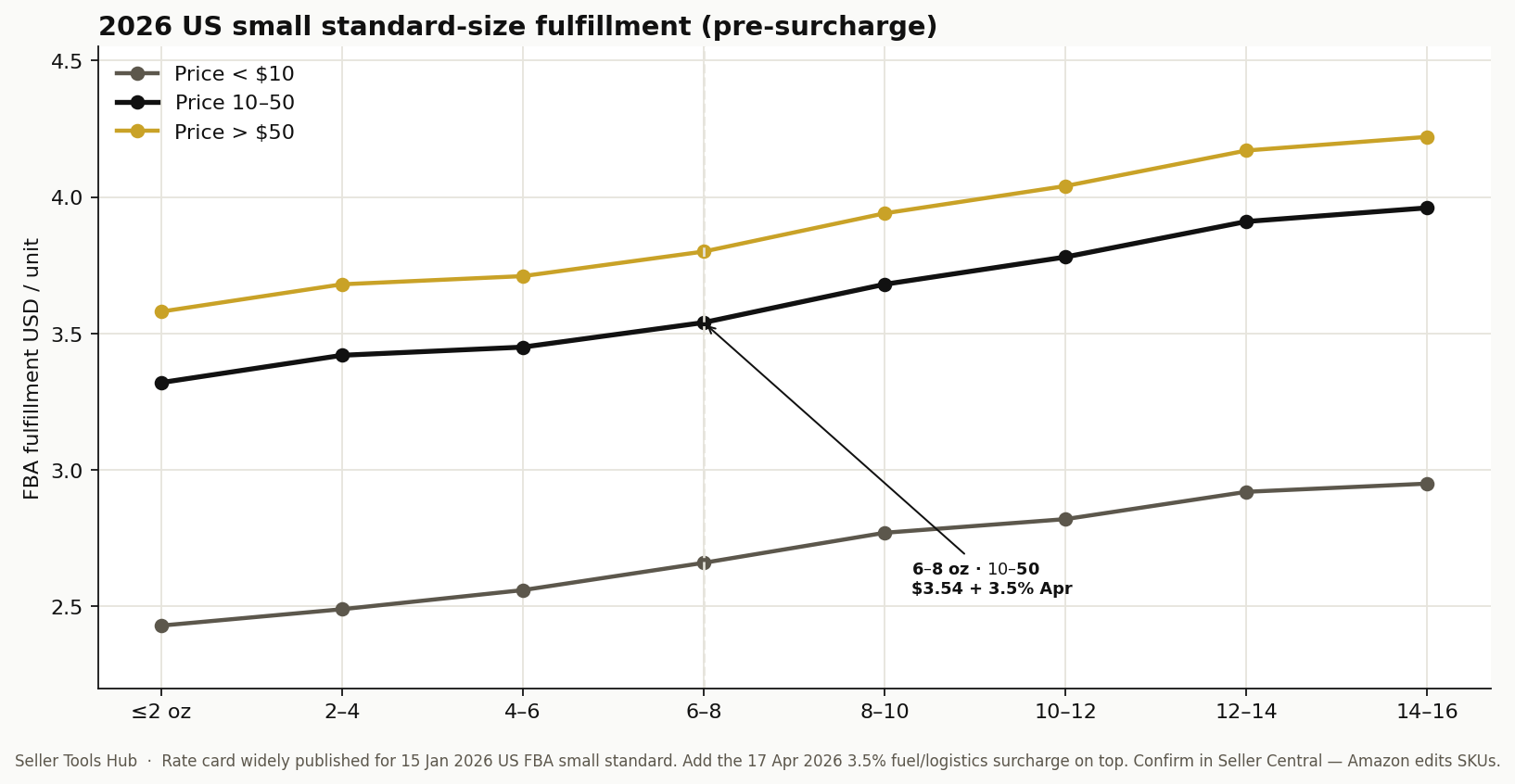
| Shipping weight | Price < $10 | $10–$50 | Price > $50 |
|---|---|---|---|
| 2 oz or less | $2.43 | $3.32 | $3.58 |
| 2+ to 4 oz | $2.49 | $3.42 | $3.68 |
| 4+ to 6 oz | $2.56 | $3.45 | $3.71 |
| 6+ to 8 oz | $2.66 | $3.54 | $3.80 |
| 8+ to 10 oz | $2.77 | $3.68 | $3.94 |
| 10+ to 12 oz | $2.82 | $3.78 | $4.04 |
| 12+ to 14 oz | $2.92 | $3.91 | $4.17 |
| 14+ to 16 oz | $2.95 | $3.96 | $4.22 |
These are the widely published 15 January 2026 US small-standard bands. Amazon can and does edit them. We check them the same way we check Helium 10 Profits — against Seller Central, not against a spreadsheet from last spring.
Storage is the fee amateurs still do not model
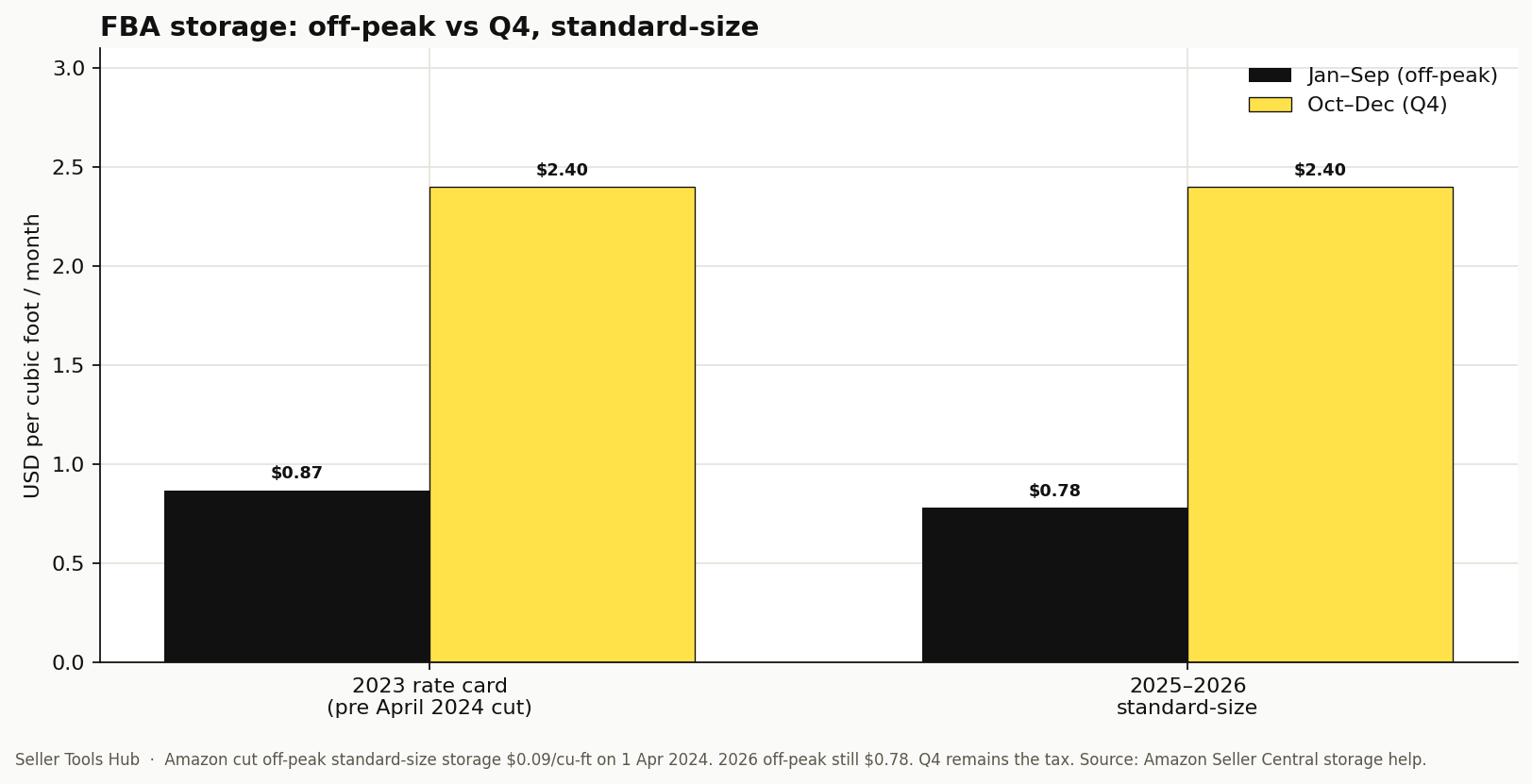
Fulfillment is a cost of a sale. Storage is a cost of a forecast. Amazon spent a decade teaching sellers that Q4 storage is a different product. In April 2024 they even cut off-peak standard-size storage by nine cents a cubic foot. Off-peak 2026 still sits at $0.78 / cu-ft / month for standard-size (Amazon’s own storage examples use that $0.78 July rate). Oversize off-peak is $0.56.
Q4 is the knife. Standard-size peak storage has lived around $2.40 / cu-ft in the mid-2020s. Some 2026 recaps cite $2.25. Either way it is triple off-peak. If you inbound 90 days of cover on 1 September because Keepa looked pretty in July, you are financing Amazon’s warehouse through Prime Day leftovers and into January aged fees.
Utilization surcharges (from April 2023) stack on top when your inventory age versus outbound looks sloppy. Aged inventory is its own ladder — and in January 2026 Amazon added a 456-days-or-more rung that operator recaps put at about $7.90 / cu-ft or $0.35 per unit, whichever is higher. That is not a storage fee. That is a eviction notice with a price tag.
Inventory tools exist because of this paragraph. SoStocked still wins inbound planning for a lot of catalogs. Helium 10’s inventory module is fine until restock limits are the actual job. Score it that way on the Helium 10 review.
Apparel, oversized, and the SKUs the average hides
Amazon’s “average +$0.08” is a blend. Apparel has lived on a different rate card for years — often cheaper outbound on small light units, nastier on returns. If you sell tees, you already know the return processing line is the real FBA fee. Do not copy a home-and-kitchen model into apparel and call it research. Size-tier still wins: a folded shirt that tips into large standard because of the poly bag is a different business than the same shirt in a smaller pack.
Oversized is where amateurs still get slaughtered by cubic feet. Off-peak oversize storage at $0.56 looks friendly until Q4 at $1.40 and a long-side that Amazon re-tiered on you. We have killed more “SmartScout looks huge” ideas with a tape measure than with Cerebro. If the longest side wants 60 inches of forgiveness, you do not have a product. You have a freight company.
Dangerous goods, hazmat, and anything that needed a peak surcharge in late 2022 should be modeled as a separate P&L. Amazon has used holiday outbound surcharges on those lanes before. If your category got hit once, assume it can get hit again. That is not paranoia. That is 2022–2023 on a loop.
Price-band fulfillment in 2026 is the new trap for “premium” small standard. Crossing $50 on a gadget that still ships in a bubble mailer used to be a brand win. Now it can be a fifty-cent fulfillment penalty before the 3.5% surcharge. If you were about to take a $47.99 SKU to $52 because a listing tweaker said so, run the FBA calculator on both prices. Sometimes the Buy Box wants $49.99 for a reason that is not psychology. It is the rate card.
A 12-month fee calendar we actually run
January: new fulfillment card lands. Rebuild the sheet. Do not wait for a blog. Open Seller Central, export the SKUs that make 80% of contribution, and re-price or kill.
March–April: inbound placement and, in 2026, a fuel surcharge. If you were going to concentrate freight into one gateway to “save on trucking,” price the placement fee against the truck. We have watched people save $400 on a lane and spend $1,200 on placement. That is not logistics. That is a vibe.
June–July: Prime-ish volume. This is when storage looks cheap and everyone inbounds like Q4 is a myth. Keepa the out-of-stock risk, then inbound cover, not a hug.
August: last honest month to be thin into Q4. If you are still sending 90 days of cover after week two of August, you are volunteering for $2.40 storage and an aged conversation in January.
October–December: storage is the product. Aged clocks do not pause because you are “investing in the brand.” Returns spike. TACOS lies if you only watch ACOS.
The calendar is the review. Software that cannot show you this calendar — restock limits, inbound, aged — is a research toy. That is why we still send people to Keepa even when they already pay for a suite. Charts over vibes. Always.
Worked example: one $24.99, 8 oz unit, three eras
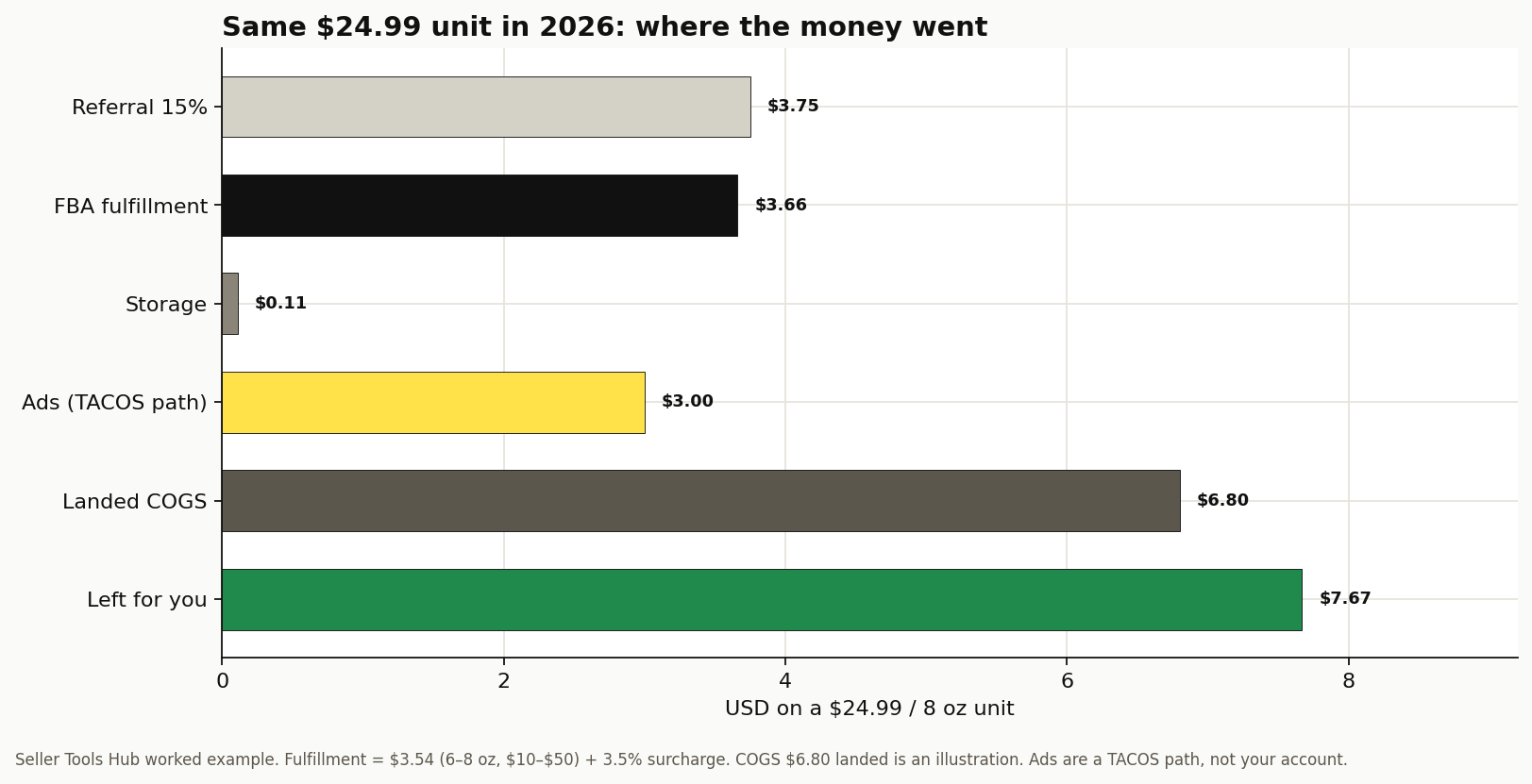
Take a poly-bagged standard-size thing at $24.99, eight ounces, about 0.05 cubic feet. Fifteen percent referral is $3.75 in every era unless Amazon rewrote that category (they sometimes do on apparel under $20 — not this SKU).
Fulfillment is the line that crawled. Storage is a few cents a month until you miss Q4. Ads are the line sellers still call “optional” while they watch TACOS eat the listing. The chart is a worked example, not Amazon’s average item. We would rather be explicit than fake a national average.
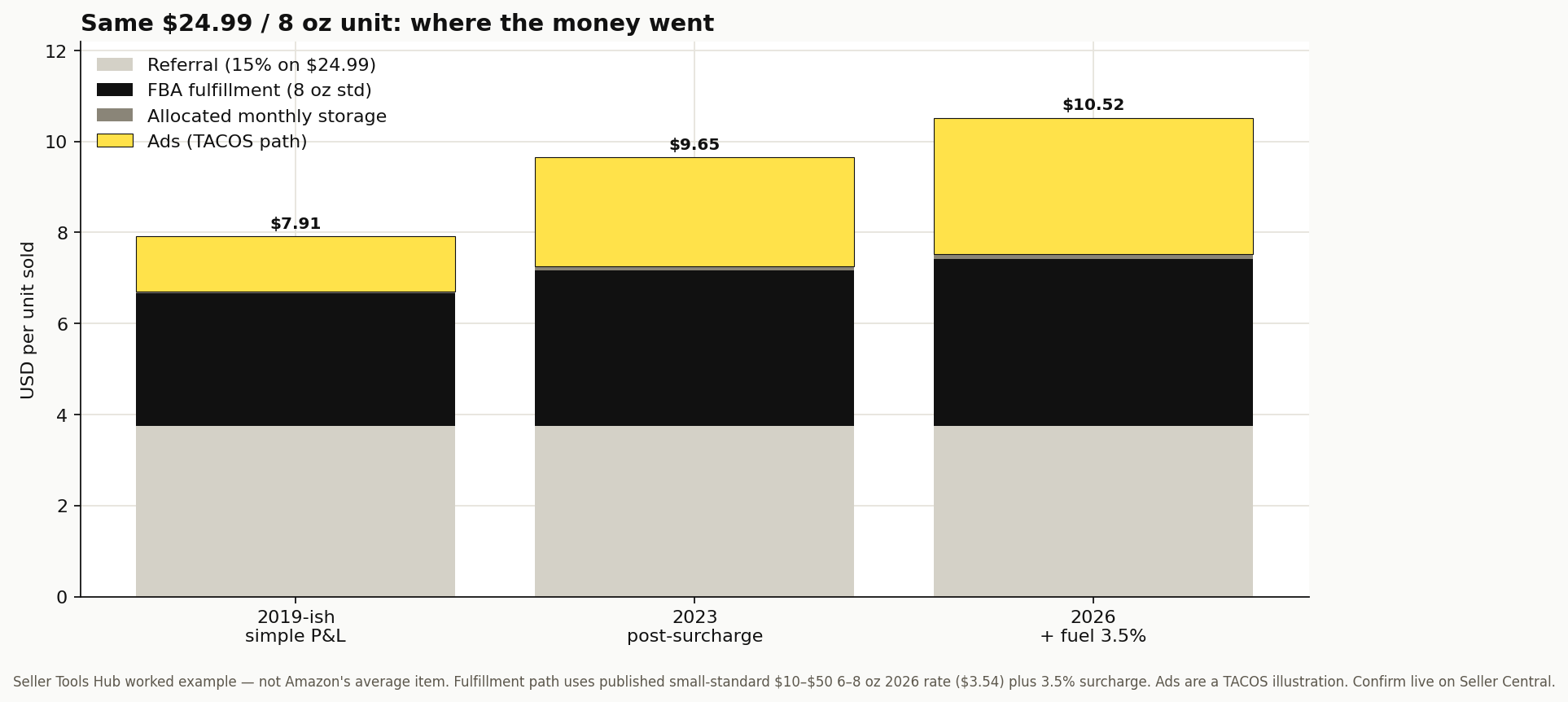
| Line | ~2019 simple P&L | 2023 (surcharge folded in) | 2026 (Jan card + Apr 3.5%) |
|---|---|---|---|
| Referral 15% | $3.75 | $3.75 | $3.75 |
| FBA fulfillment (path) | ~$2.92 | ~$3.41 | ~$3.66 |
| Allocated storage | ~$0.04 | ~$0.09 | ~$0.11 |
| Ads on the unit (illustration) | $1.20 | $2.40 | $3.00 |
| Fee stack before COGS | ~$7.91 | ~$9.65 | ~$10.52 |
If your China cost is $6.80 landed and you still think you have a 40% margin, you are doing last decade’s arithmetic. Plug the same SKU into the profit calculator and the break-even ACOS tool. Then decide whether Helium 10 Ads at Diamond + 2% of spend is a software problem or a math problem. (It is a math problem. Software can still light the money on fire faster.)
Inbound placement, returns, and the fees that never make the tweet
March 2024’s inbound placement fee is Amazon saying: you will split freight across the network or you will pay us to pretend you did. If your 3PL sends one 53-foot to New Jersey because it is convenient, you are buying a fee. Plan inbound the way SoStocked wants you to plan inbound — by warehouse, not by vibe.
Returns processing has been quietly repriced across 2024–2026. A category with a 12% return rate and a $4 return fee is not a 12% nuisance. It is a different gross margin. We treat return rate as a product-research input, which is why a pretty BSR on a tiny subcategory is a trap — see BSR and the seller statistics piece.
Low-inventory-level fees have come and gone in this window. If Amazon is charging you for being too thin in the same year it surcharges you for being too old, that is not a contradiction. That is the OS teaching you to hold exactly the inventory Amazon’s network prefers. Your job is not to be a hero. Your job is to stay inside the rails with a real restock plan.
What this means for software, coupons, and the stack
Fee history is why this site exists. Research tools lie cheerfully. Keepa is the cheapest honesty you can buy — velocity, out of stock, Buy Box. Helium 10 is the keyword OS; Platinum is the plan most catalogs should live on, not Diamond, unless ads are the job. Read the Helium 10 review and the Helium 10 statistics if you are about to stack a coupon onto the wrong SKU. Deals are labeled. A code does not fix a 456-day surcharge.
PPC software will not save a size-tier mistake. If fulfillment on a bulky unit already ate the contribution, no bid optimizer is going to print margin. That is how we test PPC tools: we run them on campaigns that still have a unit worth advertising.
How we keep this page honest
Amazon will change a cell on this page. When they do, we update the table, the date, and the worked example. We do not scrape ten affiliate blogs and average them. We start from Seller Central help, Marketplace Pulse for the industry money, and the calculators we ship on this site. If a number here is wrong, email [email protected] the same day — same rule as the methodology page.
Last thing: if your 2026 plan is “I will make it up on volume,” volume is how you buy a bigger storage bill. Cut cover, respect Q4, and stop sending Amazon a three-month hug in August.
Questions catalogs actually ask us about FBA fees
- How much did Amazon raise FBA fees in 2026?
- Amazon’s own note: fulfillment up an average of $0.08 per unit from 15 January 2026, or less than 0.5% of an average item’s selling price. That average hides the catalog. Small standard $10–$50 moved about $0.25. Small standard over $50 moved about $0.51. Large standard under $10 did not move. Then 17 April added a 3.5% fuel and logistics surcharge on US and Canada FBA fulfillment — contemporaneous recaps put that around $0.17 a unit on an average FBA shipment. Open the live card. Do not argue with a blog.
- Did Amazon raise FBA fees in 2025?
- Mostly no. Amazon paused most US referral and FBA fulfillment increases in 2025 and did not add new fee types. Sellers heard “fees froze.” Amazon heard “do not pick a fight in a political year.” 2026 resumed the operating-system updates. Plan as if the pause was a date, not a philosophy.
- What is FBA storage in Q4 versus the rest of the year?
- Off-peak standard-size storage is $0.78 per cubic foot per month after the 1 April 2024 cut of $0.09. Q4 has lived around $2.40 / cu-ft in the mid-2020s (some 2026 recaps cite $2.25). Either way it is roughly triple. Oversized off-peak $0.56 looks friendly until peak. Run the storage calculator before you inbound 90 days of cover on 1 September.
- What is the April 2026 fuel surcharge and does it stack?
- Yes. It is 3.5% of the FBA fulfillment fee, US and Canada, from 17 April 2026. It sits on top of the January rate card. A $3.54 pick-pack-ship becomes about $3.66 before you have discussed ads. Amazon’s help text is the source of truth; we link it below.
- Which Amazon seller tools actually help with FBA fees?
- Keepa for velocity and stock-out risk so you do not over-inbound. Sellerboard for a P&L that matches settlements. SoStocked when restock limits and inbound planning are the job. Helium 10 Platinum for the keyword OS — not Diamond on day one, and not because a coupon exists. See how we test.
Sources
- Amazon Selling Partner / Seller Central, “Update to U.S. Referral and Fulfillment by Amazon fees for 2026” (15 Oct 2025) — average fulfillment +$0.08 / unit effective 15 January 2026; no new fee types. Details page G201411300. Announcement: sellingpartners.aboutamazon.com.
- Amazon Seller Central, 2026 US FBA fulfillment fee changes — 17 April 2026 3.5% fuel and logistics surcharge, US and Canada. GABBX6GZPA8MSZGW.
- Amazon Seller Central, monthly inventory storage fees / 1 April 2024 off-peak standard-size cut of $0.09 per cubic foot. 2026 examples still use $0.78 off-peak standard-size.
- Amazon Seller Central FBA profitability calculator — live check against any number on this page. FBA Revenue Calculator.
- Contemporaneous 2020–2023 fulfillment notices (18 Feb 2020 ~3%, 1 Jun 2021 ~2–3%, 28 Apr 2022 5% fuel surcharge, 17 Jan 2023 ~$0.22 folded in; inbound placement 1 Mar 2024) as compiled in operator timelines and Amazon’s own fee emails to sellers.